
Choosing the right thermal management system for your chemical processes is not just a technical decision—it’s a financial and operational one. Whether you are scaling up a pilot plant or optimizing a large-scale production line, the debate between Internal Coil and Jacketed Reactors is a frequent one.
At Aries Fabricators, we understand that every chemical reaction has its own “thermal personality.” Some require the brute force of rapid cooling, while others demand the gentle, uniform touch of a heating jacket. In this guide, we break down the critical differences between internal coil and jacketed reactors to help you make an informed choice for your next project.
Understanding the Basics: What are Internal Coil and Jacketed Reactors?
Before diving into the technical nuances, let’s define our contenders.
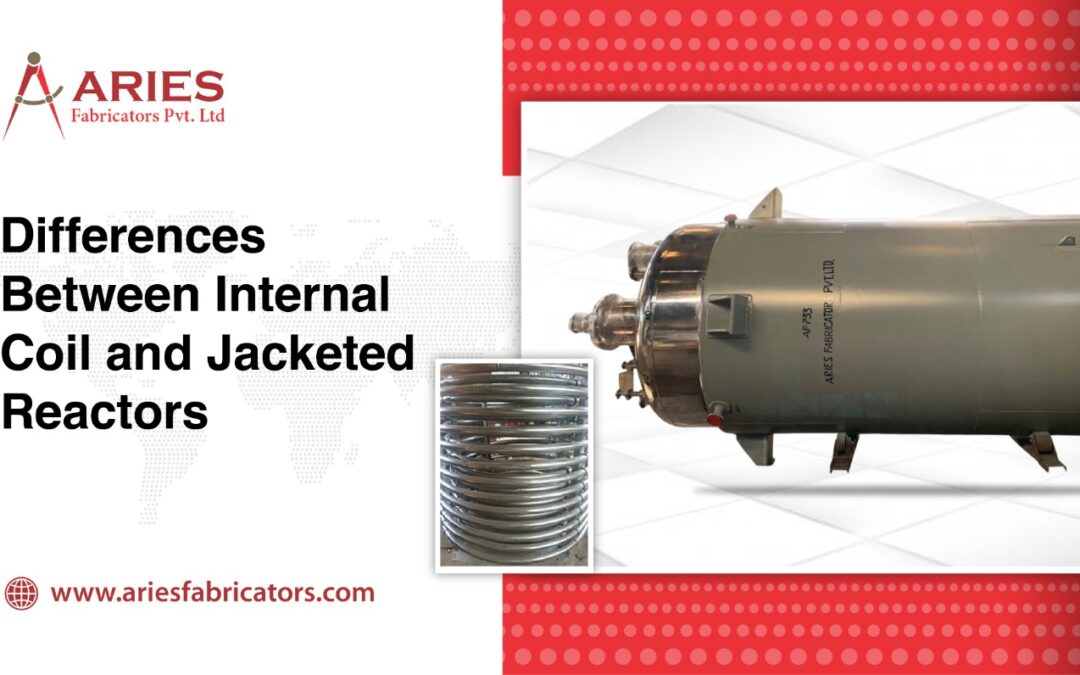
A Jacketed Reactor consists of a vessel surrounded by a secondary outer shell—the “jacket.” A heating or cooling fluid (like steam, oil, or water) circulates through the space between the vessel wall and the jacket, transferring heat through the reactor’s surface area.
An Internal Coil Reactor, on the other hand, features a series of pipes or coils placed directly inside the reaction mass. The heat transfer fluid flows through these coils, putting the thermal medium in direct contact with the product being processed.
Key Differences Between Internal Coil and Jacketed Reactors
While both systems serve the same ultimate goal—maintaining process temperature—their mechanical approach leads to significant differences in performance, maintenance, and cost.
1. Heat Transfer Efficiency and Surface Area
The most immediate difference between internal coil and jacketed reactors is the available surface area.
- Internal Coils: Because coils are submerged within the liquid, they typically offer a much larger heat transfer area relative to the volume of the product. This makes them exceptionally efficient for highly exothermic reactions where rapid heat removal is a safety priority.
- Jacketed Reactors: The heat transfer is limited to the outer wall of the vessel. While modern designs like limpet coils or dimpled jackets improve turbulence and efficiency, they generally cannot match the aggressive cooling/heating speeds of an internal coil.
2. Cleanability and Product Integrity
In industries like pharmaceuticals or fine chemicals, “cleanability” is often the deciding factor.
- Jacketed Reactors: These are the clear winners for high-purity applications. Since the heat transfer system is outside the vessel, the internal chamber remains smooth and unobstructed. This makes CIP (Cleaning-in-Place) procedures straightforward and minimizes the risk of cross-contamination between batches.
- Internal Coils: The presence of coils inside the tank creates “dead zones” where material can accumulate. Cleaning around and behind the coils is notoriously difficult, which can be a deal-breaker for processes involving sticky resins or products that require 100% purity.
3. Agitation and Mixing Dynamics
Effective heat transfer depends heavily on how well the fluid is mixed.
- Jacketed Reactors: These allow for the use of any agitator type (anchor, turbine, or propeller) without interference. The fluid flows freely against the heated walls.
- Internal Coils: The coils themselves can act as baffles, which might help with mixing in some cases. However, they can also obstruct the flow of high-viscosity fluids, leading to localized “hot spots” if the agitation is not precisely engineered to work around the coil structure.
4. Pressure and Safety Considerations
Safety is paramount when dealing with high-pressure steam or volatile chemicals.
- Jacketed Reactors: Standard jackets are limited by the pressure the outer shell can handle without deforming the inner vessel. For higher pressures, manufacturers often turn to Limpet Coil Reactors, which provide the benefits of a jacket with the pressure resistance of a pipe.
- Internal Coils: Because the pressure is contained within the small diameter of the coil pipe, they can handle significantly higher utility pressures (like high-pressure steam) more safely and economically than a full jacket.
Which One Should You Choose?
Deciding based on the differences between internal coil and jacketed reactors usually comes down to your specific application:
- Choose a Jacketed Reactor if: You are in the pharmaceutical or food industry, require frequent product changes, or handle high-viscosity materials that need a smooth internal surface for consistent mixing.
- Choose an Internal Coil Reactor if: You are managing highly exothermic reactions (like polymerization), need to heat/cool a large volume very quickly, or are working with high-pressure thermal fluids.
The Aries Fabricators Advantage
At Aries Fabricators, we don’t believe in one-size-fits-all solutions. With over 25 years of expertise in chemical equipment manufacturing, we design reactors that are compliant with ASME, TEMA, and GMP standards. Whether you need a high-polish stainless steel jacketed reactor for an API plant or a rugged internal coil vessel for resin manufacturing, our team ensures every weld and every coil is optimized for your ROI.
We also specialize in Limpet Coil Reactors, a hybrid solution that offers the high-pressure capabilities of coils with the external mounting benefits of a jacket—giving you the best of both worlds.
Conclusion
Understanding the differences between internal coil and jacketed reactors is the first step toward optimizing your production cycle. While internal coils offer superior heat transfer surface area and pressure handling, jacketed reactors provide unmatched ease of cleaning and versatility. By weighing your priorities—be it speed, purity, or budget—you can select the vessel that will drive your process forward safely and efficiently.
Ready to upgrade your chemical processing setup? Don’t leave your thermal efficiency to chance. Consult with the experts at Aries Fabricators today to design a custom reactor tailored to your specific chemical requirements.
Recent Comments