
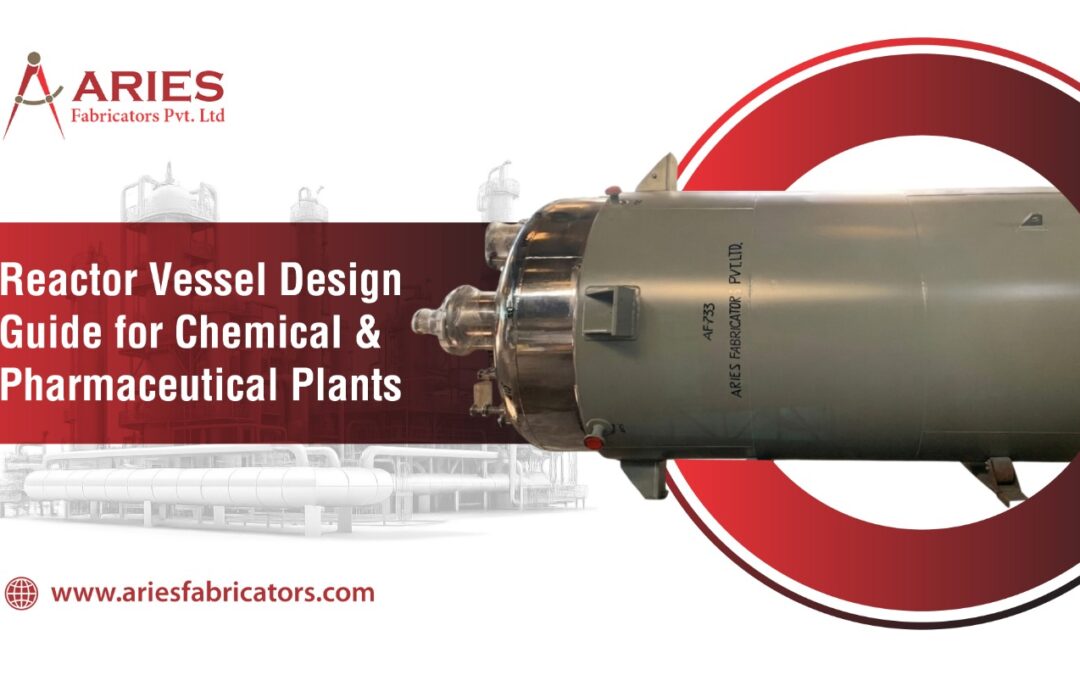
A reactor vessel isn’t just a steel container — it’s the operational heart of your plant. Get the design right, and every downstream process works better. Get it wrong, and you pay for it in yield loss, downtime, and safety risk. Whether you’re scaling up a bulk drug synthesis line or running continuous polymerization in a resin plant, the reactor vessel design you choose defines how efficiently — and safely — your process runs. Yet for many plant engineers and procurement managers, the selection process remains more intuition than methodology. At Aries Fabricators, we’ve spent over 30 years working closely with chemical and pharmaceutical plants across India — and the questions that come up before fabrication
begins are almost always the same. This guide breaks down the core design considerations for chemical plant reactor vessels and pharmaceutical reactor vessels, helping you ask the right questions before a single spec sheet is drawn up.
Why Reactor Vessel Design Matters More Than You Think
Most process failures don’t originate in poor chemistry — they originate in poor engineering fit. A reactor vessel that can’t maintain uniform temperature distribution will produce batch inconsistencies. One that isn’t rated for your operating pressure becomes a liability every time your team pushes it near the limit. For pharmaceutical plant reactors, the stakes are even higher. Regulatory compliance (GMP, cGMP), material traceability, and contamination prevention aren’t optional
checkboxes — they’re the boundary conditions within which your entire design must operate. Key point: The most expensive reactor vessel isn’t the one with the highest price tag — it’s the one that requires unplanned shutdown three months into
production because it wasn’t designed for your actual operating conditions.
Types of Reactor Vessels Used in Chemical & Pharmaceutical Plants
There is no single “standard” reactor. The right type depends on your reaction chemistry, heat transfer requirements, pressure profile, and the nature of the materials involved. At Aries Fabricators, we manufacture all of the following reactor vessel types — each designed to suit a specific process environment:
Jacketed Reactor
Ideal for temperature-sensitive reactions. The outer jacket circulates heating or cooling media around the vessel shell for precise thermal control.
Internal Coil Reactor
Helical coils inside the vessel offer superior heat transfer area, particularly useful for high-viscosity batches or exothermic reactions.
Limpet Coil Reactor
Half-pipe coils welded to the outer shell combine the benefits of jacketed and coil designs with better structural integrity and flow efficiency.
MS Rubber-Lined Reactor
Rubber lining protects mild steel against corrosive acids and solvents. Common in dye, agrochemical, and chlorination processes.
MS Lead Bond Reactor
Lead lining offers exceptional resistance to sulfuric acid and chlorinated environments where stainless steel would be unsuitable. Each reactor vessel type is engineered for a specific set of process conditions. Choosing the wrong type — even a well-fabricated one — will cost you efficiency and reliability.
Critical Design Parameters Every Engineer Should Define
Before engaging a fabricator, your engineering team should have clear answers to these core design parameters. They shape every downstream decision in the fabrication process.
1. Material of Construction
The choice between SS 304, SS 316L, Hastelloy, or lined mild steel isn’t cosmetic — it’s driven by corrosion resistance, cleanability, and compatibility with your process media. For most pharmaceutical reactor vessel applications, SS 316L is the baseline for wetted surfaces due to its low carbon content and superior corrosion resistance. Chemical plants handling aggressive solvents or acids may require exotic alloys or lined construction. Aries Fabricators works with all these material grades and helps clients select the right one based on their actual process chemistry — not just industry defaults.
2. Operating Pressure and Temperature
Design pressure should always include a safety factor above maximum operating pressure — typically 10–25% depending on applicable standards (IS 2825, ASME Sec VIII). Design temperature must account for thermal excursions, not just steady-state
conditions. Underspecifying either parameter is one of the most common — and costliest — reactor vessel design errors.
3. Agitation System
The impeller type, shaft seal, and drive configuration must match your fluid’s rheology. Anchor agitators work well for viscous products; pitched blade turbines handle lower-viscosity applications with faster mixing requirements. In pharmaceutical plants, mechanical seal design also plays a role in contamination control and cleanability.
4. Heat Transfer Area
Adequate heat transfer surface is essential for managing exothermic reactions and maintaining product quality. Undersized jackets or coils lead to prolonged cycle times and batch-to-batch variation — a particularly critical issue in pharmaceutical
manufacturing reactor environments.
“The best reactor vessel design is not the most complex one — it’s the one
that fits your process so precisely that it becomes invisible in your
operation.”
Compliance & Quality Standards in Reactor Vessel Fabrication
For pharmaceutical reactor vessel design, regulatory compliance isn’t a formality — it’s a functional requirement. GMP-compliant reactors must meet strict surface finish standards (typically Ra ≤ 0.8 µm for product-contact surfaces), have full material traceability (Mill Test Reports for all wetted parts), and support clean-in-place (CIP) or steam-in-place (SIP) protocols where required.
- IS 2825 / ASME Sec VIII pressure vessel code compliance
- Hydrostatic and pneumatic pressure testing with certified reports
- Third-party inspection at fabrication stage (not just on delivery)
- Material traceability and Mill Test Certificates for all process-contact materials
- Surface finish documentation for pharmaceutical-grade vessels
- Nozzle orientation and manhole access designed for your specific P&ID A fabricator who resists third-party inspection or cannot provide traceable documentation is a fabricator you should not be working with — regardless of price. At
Aries Fabricators, every reactor vessel we deliver includes full hydrostatic and pneumatic pressure test reports, third-party inspection certificates, and material traceability documentation as standard — not as an add-on.
Common Reactor Vessel Design Mistakes to Avoid
After over three decades of fabricating reactor vessels for chemical and pharmaceutical plants across India, the Aries Fabricators engineering team has seen certain patterns of specification errors come up repeatedly:
- Underspecifying nozzle sizes — future process modifications become expensive retrofits
- Ignoring thermal cycling fatigue — jacketed vessels subject to frequent heating/cooling cycles require appropriate shell thickness and weld design
- Overlooking cleanability — dead legs, sharp internal corners, and inaccessible welds compromise both cleaning and sterility in pharma environments
- Choosing the wrong agitator seal — incorrect seal selection leads to product contamination or early seal failure
- Skipping proper P&ID review before fabrication — nozzle placements finalized after fab start result in costly rework
Conclusion: Good Design Pays for Itself
A well-designed reactor vessel for chemical and pharmaceutical plants is fundamentally an investment in your process reliability. The time spent defining the right design parameters — material of construction, pressure ratings, heat transfer requirements, agitation design, and compliance specifications — pays dividends every single batch,
every single year. Don’t treat reactor vessel procurement as a commodity purchase. The difference between a vessel engineered to your process and one that merely meets the minimum spec often shows up six months into production, when it’s most expensive to fix. At Aries Fabricators, we’ve been engineering and fabricating reactor vessels for
chemical and pharmaceutical plants since 1992. Every vessel we build goes through hydrostatic and pneumatic pressure testing, third-party inspection, and full documentation — so you get not just the equipment, but the confidence to run it.
Ready to Design the Right Reactor Vessel for Your Plant?
Tell us your process conditions and let our engineering team propose the optimal reactor vessel design — from material selection to final inspection.
Contact us today: https://ariesfabricators.com/contact-us/
Phone: +91-9004-713-870
Email: info@ariesfabricators.com
Mumbai-based | ISO 9001:2008 | 30+ Years Experience | Chemical & Pharma Specialists
Recent Comments