
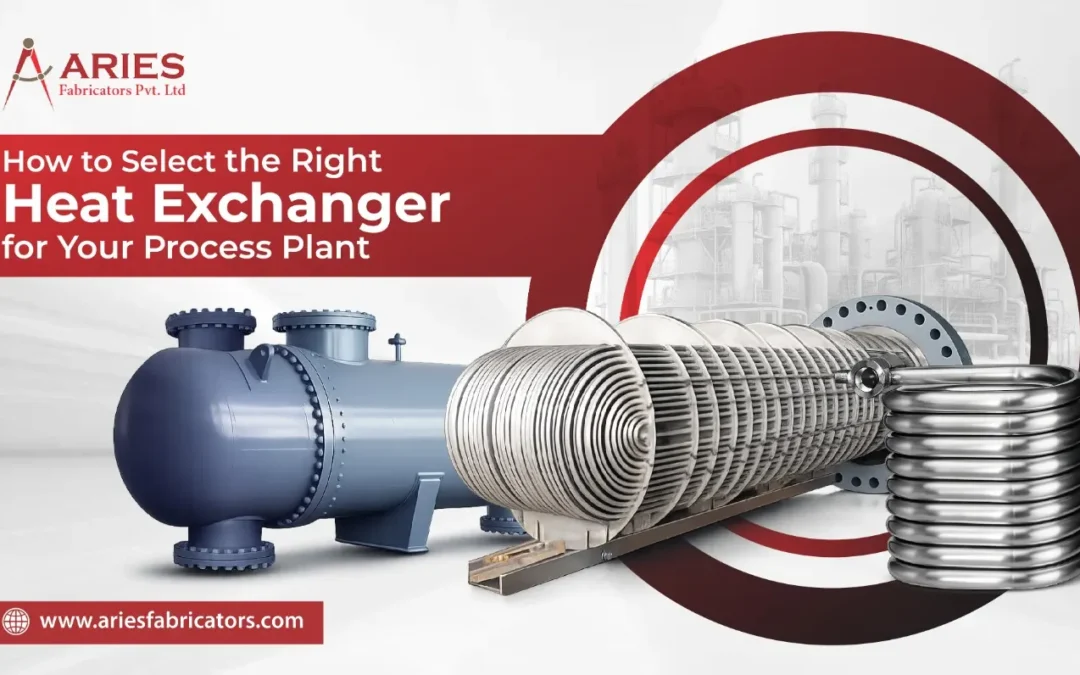
Choosing the right heat exchanger for your process plant is one of the most consequential engineering decisions you will make. Get it right, and you enjoy consistent thermal efficiency, low maintenance costs, and a long equipment lifespan. Get it wrong, and you face unplanned shutdowns, premature failures, and expensive retrofits.
At Aries Fabricators, we have been designing and manufacturing precision-engineered heat exchangers for the pharmaceutical, petrochemical, specialty chemical, and paint industries since 1992. Over the decades, we have seen the costly mistakes that arise from poor heat exchanger selection — and this guide is designed to help you avoid them.
Whether you are designing a new plant or upgrading existing process equipment, the following framework will help you make an informed, confident decision..
1. Start with Your Process Requirements
Before evaluating heat exchanger types, you need a thorough understanding of your process parameters. These are the non-negotiables that will drive every other selection decision.
Key process data to gather upfront:
- Operating temperature and pressure on both the shell side and tube side
- Flow rates and physical state of the fluids (liquid, gas, or two-phase)
- Fluid viscosity, thermal conductivity, and specific heat
- Corrosivity and fouling tendency of the process fluid
- Maximum permitted pressure loss from inlet to outlet of the heat exchanger
- Required heat duty (in kW or kcal/hr)
Skipping this step is the single most common cause of heat exchanger underperformance. Spend time here — it pays off downstream.
2. Know Your Heat Exchanger Types and When to Use Each
There is no universal “best” heat exchanger. Every configuration is purpose-built to perform under a specific set of operating conditions. Here is a practical breakdown of the most commonly used configurations in process plants.
Shell and Tube Heat Exchangers
Shell and tube heat exchangers are the workhorse of the process industry. A series of tubes are housed inside a cylindrical outer shell, forming the core structure of the unit. One fluid runs through the tubes while the other circulates around them within the shell.
Best suited for:
- High-pressure and high-temperature applications
- Large heat transfer surface area requirements
- Multi-phase fluid handling (condensers, reboilers, evaporators)
- Processes requiring mechanical cleaning access
Aries Fabricators manufactures shell and tube heat exchangers to TEMA standards, with customisation options for baffles, tube pitch, and material selection to match your specific process fluid conditions.
Fixed Tube Heat Exchangers
Fixed tube sheet designs have tube sheets permanently welded to the shell. They offer a compact, cost-effective solution where differential thermal expansion between the shell and tubes is not a concern, or where an expansion joint is incorporated into the design.
Best suited for:
- Clean shell-side fluids that do not require mechanical cleaning
- Applications with low temperature differentials between shell and tube fluids
- Where cost optimisation is a priority without compromising heat transfer performance
Tube and Tube (Double Pipe) Heat Exchangers
Also known as double pipe heat exchangers, this design features one pipe inside another, allowing two fluids to exchange heat in either co-current or counter-current flow. They are simple to design, inspect, and maintain.
Best suited for:
- Hygienic processes in pharmaceutical and food-grade applications
- Small-scale processes or pilot plant applications
- High-viscosity or fouling fluids requiring frequent cleaning
- True counter-current flow for maximum temperature driving force
3. Select the Right Material of Construction
Material selection is directly tied to the chemical compatibility of your process fluids, operating temperatures, and the risk of corrosion. A poorly chosen material can lead to tube failure, contamination of the product stream, or a complete heat exchanger breakdown within months of installation.
Common materials used in process plant heat exchangers:
- Carbon Steel — Cost-effective for non-corrosive services; widely used in utilities
- Stainless Steel (SS 304 / SS 316L) — Excellent for corrosive chemicals, pharmaceutical-grade, and food-contact fluids
- Duplex / Super Duplex Steel — Superior resistance to chloride stress corrosion cracking in aggressive environments
- Hastelloy / Titanium — For extremely corrosive acids, oxidisers, and high-purity applications
- Copper Alloys — Often used in HVAC and low-pressure steam applications
At Aries Fabricators, material selection is never an afterthought. Our engineering team evaluates chemical compatibility data and operating conditions before recommending a material of construction — and every batch of material comes with a certified test report.
4. Consider Thermal Design and Heat Transfer Efficiency
The thermal design of a heat exchanger determines how efficiently it will transfer heat under real operating conditions. A heat exchanger that looks adequately sized on paper may underperform significantly if fouling factors, fluid maldistribution, or poor baffle design are overlooked.
Key thermal design considerations include:
- Log Mean Temperature Difference (LMTD) and correction factors for multi-pass arrangements
- Overall heat transfer coefficient (U-value) based on realistic fouling allowances
- Tube-side versus shell-side assignment of hot and cold streams for optimal thermal efficiency
- Baffle arrangement and segmental cut ratio to optimise shell-side thermal performance while keeping pressure loss within acceptable limits
- Number of tube passes to achieve the required outlet temperatures
Investing in a proper thermal design — rather than purchasing off-the-shelf based only on area — is what separates a reliable heat exchanger installation from a recurring maintenance problem.
5. Factor in Maintenance, Cleaning, and Long-Term Operability
Heat exchangers in process plants are not install-and-forget equipment. Fouling, scaling, and corrosion are continuous concerns. When selecting a heat exchanger, consider how easy it will be to inspect, clean, and maintain over its operational life.
- Floating head or U-tube designs allow tube bundle removal for mechanical cleaning when shell-side fouling is a concern
- Fixed tube sheet exchangers are cheaper but require chemical cleaning on the shell side
- Double pipe designs offer the easiest access for cleaning and inspection
- Plan for sufficient nozzle connections and isolation valves to support online or offline maintenance
A heat exchanger that is difficult to maintain will cost you far more in downtime and labour over its lifecycle than any initial savings in purchase price.
6. Verify Compliance and Quality Certifications
For regulated industries such as pharmaceuticals, bulk drugs, and specialty chemicals, heat exchanger selection must also account for relevant manufacturing standards and statutory approvals. This includes pressure vessel codes (ASME, IBR), material traceability, and third-party inspection requirements.
Aries Fabricators, an ISO 9001:2008 certified manufacturer, subjects every heat exchanger to hydrostatic pressure testing and third-party inspection through agencies such as Chempro, Shanty Sagar Inspection Agency, and Caliber Inspection Agency — so you receive full documentation and peace of mind alongside your equipment.
7. Evaluate Total Cost of Ownership, Not Just Purchase Price
It is tempting to select a heat exchanger based on the lowest upfront cost. But total cost of ownership (TCO) — which accounts for energy consumption, maintenance frequency, downtime costs, and expected service life — almost always tells a different story.
A well-specified heat exchanger sourced from a reputable process equipment manufacturer will typically deliver a lower TCO over a 15–20 year operational life compared to an undersized or incorrectly specified unit that requires frequent replacement or constant attention.
Conclusion
Selecting the right heat exchanger for your process plant is not a single decision — it is a series of engineering judgements informed by process data, material science, thermal design principles, and long-term operational planning.
Whether you need a shell and tube heat exchanger for a high-pressure refinery application, a fixed tube unit for an intermediate chemical process, or a compact tube-and-tube design for a pharmaceutical pilot plant, the approach remains the same: understand your process, match the design to your conditions, choose the right material, and think beyond the purchase price.
Aries Fabricators has been a trusted partner to process plants across India for over three decades. Our commitment to precision manufacturing, certified quality, and responsive after-sales support means you are not just buying a piece of equipment — you are investing in reliability.
Cảm ơn bài viết. Với dịch vụ du học Hàn Quốc chuyên nghiệp, Letco giúp bạn tiết kiệm thời gian và chi phí chuẩn bị hồ sơ. Truy cập letco.vn để biết thêm.
Saved and shared with a friend! On a related note. A former coworker put me onto https://cwge.usatkvdbuc.top/ a while back — it’s a job listings site that actually respects your time. Rather than checking a dozen sites, you see everything at once.
Fantastic write-up. This reminded me of one thing. I’ve just been using a job board at https://ozaq.fewmmc.com/ that honestly changed how I look for work. You can search by city, company and role, and new jobs land every day. Passing it along in case it’s useful.
Appreciate the details here. Came across mjmxn.com recently and it lines up well with this.