
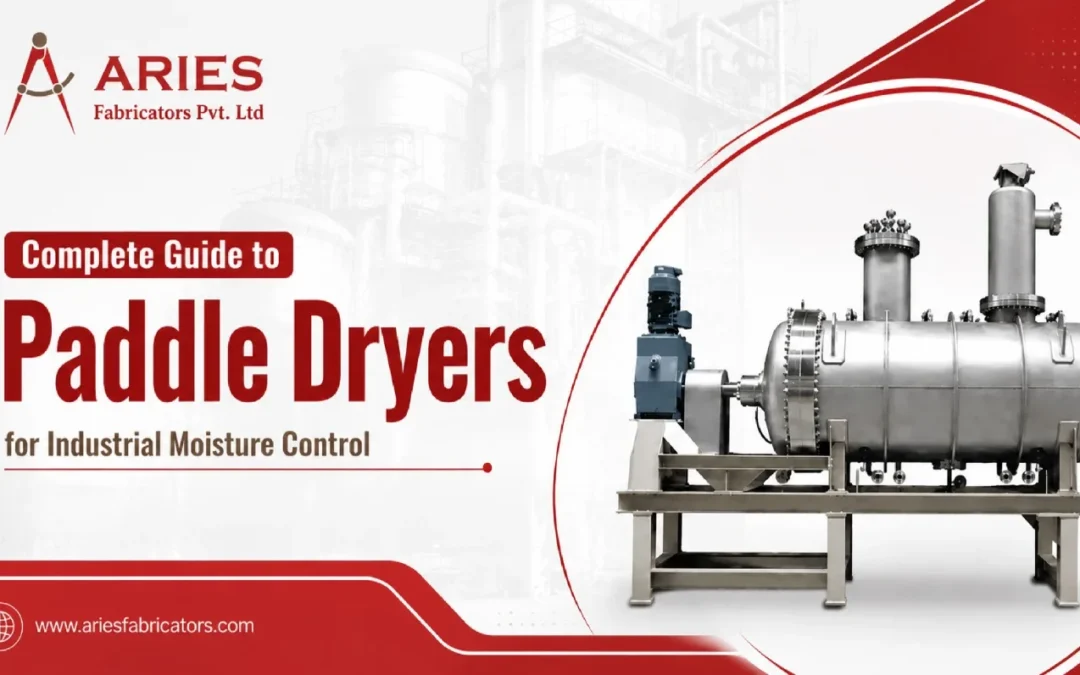
Controlling moisture is one of the most critical steps in industrial manufacturing. Whether you’re producing chemicals, pharmaceuticals, food ingredients, pigments, sludge, or specialty materials, achieving the right moisture content directly impacts product quality, storage stability, and production efficiency.
Among the various industrial drying technologies available today, Paddle Dryers have become one of the most energy-efficient and reliable solutions for drying high-moisture materials. Their indirect heating method minimizes energy loss while ensuring uniform drying without damaging heat-sensitive products.
At Aries Fabricators, we manufacture robust, high-performance Paddle Dryers designed for demanding industrial applications, offering customized solutions for continuous and batch processing requirements across multiple industries.
What is a Paddle Dryer?
A Paddle Dryer is an indirect contact dryer that removes moisture by transferring heat through hollow shafts and specially designed hollow paddles. Unlike hot air dryers, the heating medium (steam, hot oil, or thermal fluid) never comes into direct contact with the product.
Instead, heat is transferred through the heated metal surfaces while rotating paddles continuously mix the material, ensuring:
- Uniform drying
- High thermal efficiency
- Gentle material handling
- Reduced energy consumption
- Minimal dust generation
This design makes paddle dryers especially suitable for sticky, pasty, granular, crystalline, and powdery materials.
How Does a Paddle Dryer Work?
The drying process follows a simple yet highly efficient sequence:
Step 1: Material Feeding
Wet material enters the drying chamber through the feed inlet.
Step 2: Indirect Heating
Steam or thermal oil flows through:
- Hollow paddles
- Hollow rotating shaft
- Heated outer jacket
This creates a large heat transfer area.
Step 3: Continuous Mixing
The rotating paddles gently agitate and move the material throughout the chamber, ensuring every particle receives equal heat exposure.
Step 4: Moisture Evaporation
As the product heats up, moisture evaporates.
Depending on the application:
- Vapors may be condensed
- Solvents may be recovered
- Vacuum operation can lower drying temperatures for heat-sensitive products
Step 5: Product Discharge
Once the desired moisture level is achieved, the dried product exits through the discharge outlet for further processing or packaging.
Why Moisture Control Matters
Improper moisture levels can lead to:
- Product spoilage
- Reduced shelf life
- Poor chemical reactions
- Caking during storage
- Difficult packaging
- Increased transportation costs
- Lower production efficiency
A properly designed paddle dryer helps manufacturers achieve consistent moisture levels while improving overall process reliability.
Advantages of Paddle Dryers
1. High Thermal Efficiency
Because heat is transferred directly through heated surfaces, very little energy is wasted.
2. Uniform Drying
Continuous mixing prevents hotspots and ensures every particle dries evenly.
3. Low Operating Costs
Lower energy consumption compared to many conventional hot-air drying systems reduces operating expenses.
4. Suitable for Heat-Sensitive Products
Indirect heating prevents overheating, making paddle dryers ideal for products that degrade under direct flame or hot air.
5. Compact Design
Large drying capacity can be achieved within a relatively small installation footprint.
6. Dust-Free Operation
Since drying does not rely on large volumes of hot air, dust emissions are significantly reduced.
7. Solvent Recovery Capability
Vacuum-operated paddle dryers can efficiently recover valuable solvents during drying.
8. Continuous or Batch Operation
Manufacturers can choose the configuration that best matches production requirements.
Applications of Paddle Dryers
Paddle dryers are widely used across industries, including:
Chemical Industry
- Pigments
- Catalysts
- Fertilizers
- Chemical intermediates
- Specialty chemicals
Pharmaceutical Industry
- API drying
- Pharmaceutical intermediates
- Fine chemicals
Petrochemical Industry
- Polymer powders
- Catalyst drying
Food Industry
- Food additives
- Starches
- Protein powders
Environmental Industry
- Sewage sludge
- Industrial sludge
- Waste treatment
Mineral Processing
- Clay
- Fly ash
- Metal powders
- Industrial minerals
Industries That Benefit from Paddle Dryers
Aries Fabricators supplies paddle dryers for:
- Chemical Plants
- Pharmaceutical Manufacturing
- Resin Manufacturing
- Paint Industry
- Petrochemical Plants
- Specialty Chemical Manufacturers
- Fine Chemical Industries
- Waste Treatment Facilities
- Agrochemical Processing
- Industrial Minerals
These industries require precise moisture control to ensure product quality and process efficiency. (Aries Fabricators)
Types of Materials Suitable for Paddle Dryers
A paddle dryer can process:
- Powders
- Granules
- Crystals
- Sludge
- Filter cake
- Paste-like materials
- Semi-solid products
- Wet chemicals
- Biomass materials
Key Features of an Industrial Paddle Dryer
Modern paddle dryers typically include:
- Hollow paddle shaft
- Hollow paddles
- Steam or thermal oil heating
- Jacketed chamber
- Variable speed drive
- Heavy-duty gearbox
- Vapor outlet
- Feed hopper
- Product discharge system
- Optional vacuum operation
- PLC-based automation (optional)
Factors to Consider Before Choosing a Paddle Dryer
Selecting the right paddle dryer depends on several factors:
Material Characteristics
- Moisture content
- Particle size
- Stickiness
- Bulk density
- Abrasiveness
Production Capacity
Choose equipment sized to meet current output while allowing room for future expansion.
Heating Medium
Common options include:
- Steam
- Hot oil
- Thermal fluid
Required Moisture Level
Different products require different final moisture contents.
Automation Requirements
Advanced control systems improve process consistency and reduce manual intervention.
Maintenance Tips for Better Performance
Routine maintenance helps maximize equipment life and efficiency:
- Inspect paddles regularly
- Check bearings and seals
- Monitor gearbox lubrication
- Clean the chamber periodically
- Inspect steam joints
- Verify heating performance
- Calibrate sensors
- Replace worn components promptly
Preventive maintenance minimizes downtime and extends equipment lifespan.
Why Choose Aries Fabricators?
With decades of experience in manufacturing industrial process equipment, Aries Fabricators provides customized paddle dryers engineered for efficiency, durability, and reliable performance.
Our solutions offer:
- Custom-designed equipment
- High-quality fabrication
- Efficient heat transfer design
- Robust construction
- Low maintenance requirements
- Reliable after-sales support
- Compliance with industrial quality standards
- Integration with complete process plants
In addition to paddle dryers, Aries Fabricators manufactures reactors, heat exchangers, centrifuges, storage vessels, ribbon blenders, resin manufacturing plants, falling film evaporators, air receivers, and other process equipment for chemical and pharmaceutical industries.
Conclusion
Efficient moisture control is essential for maintaining product quality, improving production efficiency, and reducing operating costs. Paddle dryers offer an ideal combination of gentle product handling, high thermal efficiency, and reliable performance for a wide range of industrial applications.
Whether you operate a chemical plant, pharmaceutical facility, resin manufacturing unit, or waste treatment plant, investing in a high-quality paddle dryer can significantly improve your production process.
Aries Fabricators delivers customized paddle drying solutions designed to meet the unique requirements of modern industries, ensuring dependable performance, long service life, and optimal drying efficiency.
Recent Comments