
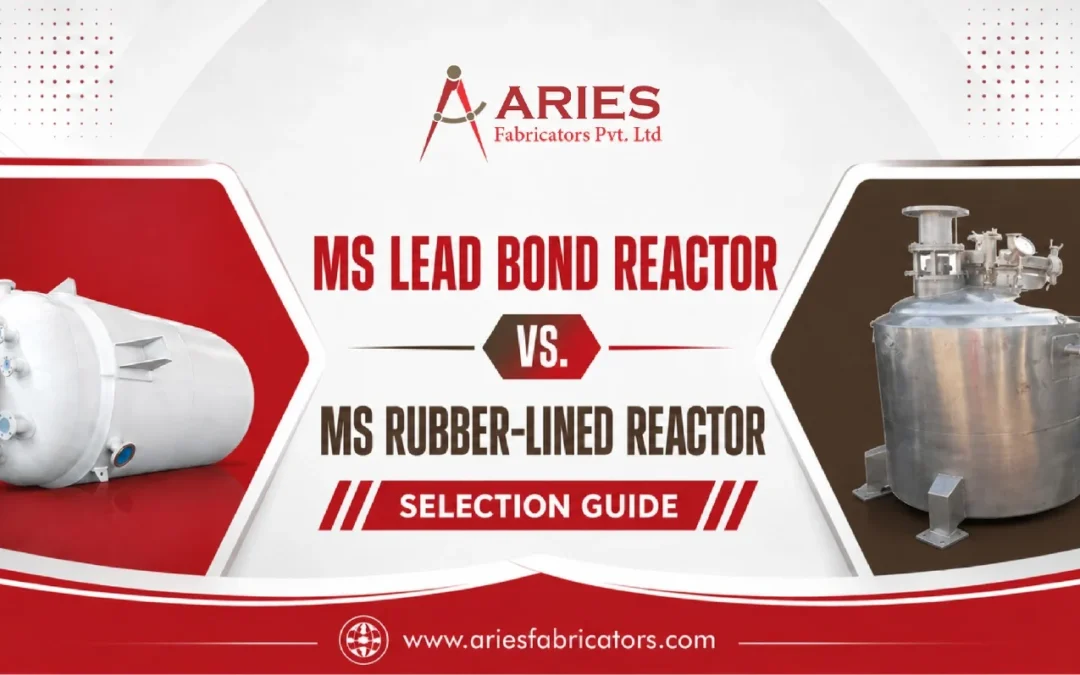
Choosing the right reactor lining is a critical decision for chemical processing applications. The lining must withstand the process chemicals, operating temperature, agitation, pressure, and cleaning conditions while protecting the mild steel vessel from corrosion.
Two commonly considered options are MS Lead Bond Reactors and MS Rubber-Lined Reactors. Although both use mild steel as the structural shell and a corrosion-resistant lining on the product-contact side, their performance characteristics and ideal applications are different.
This guide explains the key differences between MS Lead Bond Reactors and MS Rubber-Lined Reactors and provides a practical framework for selecting the right option for your process.
What Is an MS Lead Bond Reactor?
An MS Lead Bond Reactor consists of a mild steel vessel with lead bonded to the internal surface. The mild steel provides the structural strength, while the lead lining acts as a corrosion-resistant barrier between the process material and the steel shell.
Lead lining is particularly useful in processes involving aggressive acidic environments, where conventional mild steel may not provide sufficient corrosion resistance.
According to Aries Fabricators, its MS Lead Bond Reactors use 99.97% pure lead ingots, with the lead bonding carried out after fabrication and surface preparation of the reactor. The company also conducts lead-bonding quality checks such as Congo Red or HCL acid testing.
Key characteristics
- Mild steel structural shell
- Lead-lined product-contact surface
- High resistance to selected acidic environments
- Suitable for application-specific reactor designs
- Available with different agitator configurations
- Can be manufactured in GMP and non-GMP configurations
- Custom-built according to process requirements
Aries lists MS Lead Bond Reactor capacities from 450 to 15,000 litres.
What Is an MS Rubber-Lined Reactor?
An MS Rubber-Lined Reactor uses a fabricated mild steel vessel as the structural body, with a suitable rubber lining applied to the internal product-contact surfaces.
The rubber acts as a protective barrier, preventing corrosive chemicals from directly contacting the mild steel.
The important point is that rubber lining is not a single universal material. Different rubber compounds have different resistance to acids, alkalis, solvents, temperature, abrasion and other process conditions. Therefore, the lining compound must be selected according to the actual process chemistry.
Aries identifies MS rubber-lined reactors as suitable for applications involving corrosive acids and solvents, including processes in industries such as dyes, agrochemicals and chlorination.
MS Lead Bond vs. MS Rubber-Lined Reactor: Key Differences
| Parameter | MS Lead Bond Reactor | MS Rubber-Lined Reactor |
| Base construction | Mild steel | Mild steel |
| Internal protection | Lead lining | Rubber lining |
| Primary advantage | Strong resistance to selected aggressive acidic environments | Versatile corrosion protection with appropriate rubber compound |
| Chemical compatibility | Particularly suited to certain strong acidic services | Depends heavily on rubber compound and chemical exposure |
| Mechanical considerations | Lead is relatively soft and requires protection from mechanical damage | Rubber can provide flexible protective coverage but can also be damaged by sharp objects or unsuitable agitation |
| Temperature suitability | Process-specific | Highly dependent on rubber compound |
| Abrasion resistance | Process-dependent | Depends on rubber formulation and service |
| Maintenance considerations | Lead bonding integrity must be maintained | Lining condition, adhesion and holiday-free surface are critical |
| Best selection basis | Aggressive acidic chemistry where lead is compatible | Chemical compatibility, temperature and lining requirements |
| Customization | Application-specific | Application-specific |
The key takeaway: neither lining should be selected simply because it is generally considered “more corrosion resistant.” The correct choice depends on the actual process chemistry and operating conditions.
1. Chemical Compatibility Comes First
The most important factor is the chemical environment inside the reactor.
Before selecting the lining, evaluate:
- Chemical composition
- Concentration
- pH
- Operating temperature
- Exposure duration
- Batch chemistry
- Presence of oxidizing agents
- Solvents
- Abrasive particles
- Cleaning chemicals
When Lead Bonding May Be Preferred
Lead lining can be considered for processes involving aggressive acidic conditions where lead provides the required chemical resistance.
For example, Aries specifically describes its lead bonding/lining reactors as being used for reactions involving anti-corrosive and acidic components.
When Rubber Lining May Be Preferred
Rubber lining can be advantageous when the selected rubber compound provides the required resistance against the process chemicals.
However, compatibility should always be confirmed against the specific chemical, concentration and operating temperature, rather than choosing rubber lining based only on the chemical name.
2. Operating Temperature Matters
Temperature can significantly affect lining performance.
A lining that performs well at room temperature may have very different performance at an elevated process temperature.
For rubber-lined reactors in particular, the allowable operating temperature depends on:
- Rubber formulation
- Chemical concentration
- Exposure time
- Mechanical conditions
- Manufacturer specifications
Therefore, the process engineer should provide the maximum, minimum and normal operating temperatures before the lining is selected.
3. Consider Agitation and Mechanical Stress
The agitator is another important consideration.
A reactor may use different agitator configurations depending on the material being processed. Aries, for example, lists anchor, propeller, turbine and cutter stirrers for its lead-bond reactor designs.
The lining must withstand the mechanical environment created by:
- Agitator speed
- Impeller design
- Batch viscosity
- Solids concentration
- Particle size
- Baffles
- Cleaning procedures
A lining that is chemically compatible but mechanically unsuitable can still result in premature failure.
4. Think About Cleaning and Maintenance
The reactor lining is part of the overall maintenance strategy.
Regular inspection should look for:
- Cracks
- Blisters
- Disbonding
- Pinholes
- Surface damage
- Mechanical impact
- Chemical deterioration
- Areas of exposed substrate
For lead-lined equipment, bonding quality and lining integrity are particularly important. Aries describes testing procedures including Congo Red and HCL acid tests for its lead bonding/lining work.
For rubber-lined equipment, appropriate inspection and holiday detection methods should be specified according to the lining system and project requirements.
5. Don’t Ignore the Reactor’s Structural Requirements
The lining provides corrosion protection, but the mild steel shell remains responsible for the structural strength of the vessel.
The reactor design must therefore consider:
- Design pressure
- Design temperature
- Vessel diameter
- Shell thickness
- Head design
- Nozzle loads
- Agitator loads
- Vacuum conditions
- Jacket or limpet coil requirements
- Support arrangement
Aries notes that reactor vessel design should establish material of construction, operating pressure and temperature, agitation and heat-transfer requirements before fabrication.
MS Lead Bond Reactor: When Should You Consider It?
An MS Lead Bond Reactor can be considered when your process requires:
✔ Strong corrosion protection for compatible acidic services
✔ A mild steel structural vessel with a lead protective layer
✔ Application-specific reactor fabrication
✔ Reliable protection against the process medium
✔ Compatibility with selected agitation systems
It can be particularly relevant to chemical processes where the process chemistry makes lead a suitable lining material.
MS Rubber-Lined Reactor: When Should You Consider It?
An MS Rubber-Lined Reactor can be considered when:
✔ The process chemistry is compatible with the selected rubber compound
✔ Corrosion protection is required for a mild steel vessel
✔ The process requires a flexible lining system
✔ The application benefits from rubber’s chemical-resistant properties
✔ The operating temperature and mechanical conditions fall within the lining manufacturer’s specifications
A Simple Reactor Selection Checklist
Before choosing between lead bonding and rubber lining, ask these questions:
Chemical
What chemicals will contact the lining?
Concentration
At what concentration will they operate?
Temperature
What are the minimum, normal and maximum temperatures?
Agitation
What agitator type and RPM will be used?
Solids
Will the reactor contain abrasive particles or suspended solids?
Pressure
What are the operating and design pressures?
Cleaning
What cleaning chemicals and procedures will be used?
Service Life
What operating life is expected from the lining?
Inspection
What inspection and testing procedures will be required?
Once these parameters are established, the fabricator can recommend the appropriate lining system and reactor configuration.
Lead Bond vs. Rubber Lining: Which One Is Better?
There is no universal winner.
The better choice is the one that matches your actual process conditions.
Choose an MS Lead Bond Reactor when:
- The process involves compatible aggressive acidic environments.
- Lead provides the required chemical resistance.
- The process conditions are suitable for lead-lined construction.
- The application requires a robust corrosion barrier with a mild steel structural shell.
Choose an MS Rubber-Lined Reactor when:
- The selected rubber compound has proven compatibility with the process.
- The process benefits from rubber-lined corrosion protection.
- Operating temperature and mechanical conditions are suitable for the selected lining.
- The application requires a customized rubber-lined vessel.
Why Process-Specific Reactor Design Matters
A reactor should never be selected based only on capacity or lining material.
The complete system—including the vessel, lining, agitator, heating/cooling arrangement, nozzles, pressure rating and testing requirements—must be considered together.
Aries Fabricators manufactures customized reactor vessels for industries including pharmaceuticals, bulk drugs, resin, adhesives, petrochemicals, dyes, paints, specialty chemicals and fine chemicals. Its reactor range includes different configurations designed around specific process requirements.
The company also provides custom-built reactors based on client drawings or recommended configurations.
Conclusion
Selecting between an MS Lead Bond Reactor and an MS Rubber-Lined Reactor is fundamentally a chemical compatibility and process-engineering decision.
Lead bonding can be highly suitable for specific aggressive acidic applications, while rubber lining can provide versatile corrosion protection when the correct rubber compound is selected.
Before making the decision, evaluate chemical compatibility, concentration, temperature, agitation, pressure, solids, cleaning requirements and expected service life.
The right lining doesn’t just protect the reactor—it helps protect production continuity, product quality and long-term equipment reliability.
Looking for a reactor designed around your process?
Work with an experienced process-equipment manufacturer to evaluate your chemistry and operating conditions before finalizing the reactor lining.
Aries Fabricators – Reactor Vessels
your industry requirements.
Recent Comments