
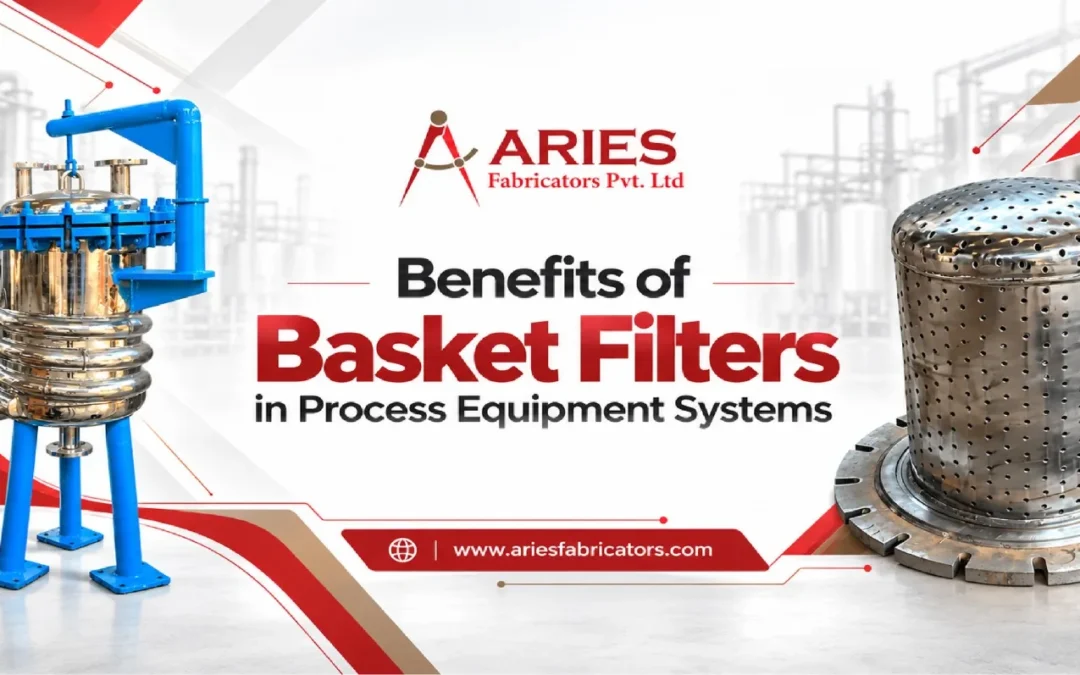
Industrial process systems must maintain reliable fluid flow while preventing unwanted particles from entering critical equipment. In chemical processing, pharmaceuticals, paints, resins, petrochemicals, and other manufacturing industries, contamination can lead to equipment damage, blockages, production interruptions, and increased maintenance costs.
A basket filter in a process equipment system helps address these challenges by capturing solid contaminants from liquid streams before they reach downstream equipment. Its simple design, reusable filtration element, and suitability for industrial applications make it a valuable component in many process plants.
In this blog, we explore the key benefits of basket filters, how they work, their industrial applications, and the factors to consider when selecting one for your process requirements.
What Is a Basket Filter?
A basket filter is an industrial filtration device designed to remove suspended solids and unwanted particles from liquids. It generally consists of a housing that contains a removable perforated or mesh basket. As process fluid passes through the basket, contaminants are retained while the filtered liquid continues through the system.
Basket filters are commonly used as pre-filtration equipment to protect pumps, valves, heat exchangers, pipelines, and other downstream components.
Depending on the process requirements, basket filters can be manufactured using materials such as stainless steel or mild steel. The selection depends on factors such as fluid compatibility, operating pressure, temperature, and the nature of the contaminants.
How Does a Basket Filter Work?
The working principle of a basket filter is straightforward:
- Fluid enters the housing: The process liquid containing suspended particles enters the filter through the inlet.
- Contaminants are captured: The liquid passes through the perforated or mesh basket, which retains particles according to the selected filtration arrangement.
- Filtered liquid exits: The liquid continues through the outlet toward the next stage of the process.
- The basket is cleaned: When accumulated contaminants begin to restrict flow or increase the pressure differential, the system is isolated and the basket is removed for cleaning, following the equipment’s operating procedure.
This process helps reduce the amount of unwanted solid material entering downstream equipment.
7 Key Benefits of Basket Filters in Process Equipment Systems
1. Protection for Critical Process Equipment
One of the primary benefits of basket filters is their ability to capture solid contaminants before they reach sensitive equipment.
Particles such as rust, scale, debris, and other suspended solids can damage or obstruct pumps, valves, spray nozzles, and heat exchanger passages. Installing a properly selected basket filter upstream can reduce the risk of particle-related problems.
This protection is particularly valuable in industrial systems where equipment reliability directly affects production schedules and operating costs.
2. Reduced Maintenance and Equipment Downtime
Contamination can contribute to frequent cleaning, unexpected blockages, and unplanned maintenance.
Basket filters help reduce these issues by collecting contaminants at a designated point in the process. Operators can inspect the basket and clean it when necessary rather than addressing particle accumulation throughout the system.
Although maintenance requirements depend on the fluid and operating conditions, a suitable basket filter can support more predictable maintenance planning and help minimize avoidable interruptions.
3. Reusable Filtration Element
Many basket filter designs feature a removable basket that can be cleaned and reused, provided it remains in suitable condition.
This can reduce the recurring cost of disposable filtration elements in applications where reusable baskets are appropriate. It can also simplify maintenance because accumulated solids are collected in one accessible location.
Routine inspection is important to identify corrosion, deformation, damage, or excessive wear. Damaged baskets and seals should be repaired or replaced as required.
4. Support for Consistent Process Quality
Unwanted particles in process fluids may affect product appearance, consistency, or downstream processing performance.
For example, contamination can interfere with fluid transfer, obstruct application equipment, or introduce unwanted solids into subsequent production stages. Basket filters help control larger or otherwise targeted particulate contaminants before they move further through the process.
The filtration performance depends on the basket’s opening size, fluid characteristics, flow rate, and operating conditions. Where fine-particle removal is necessary, additional filtration stages may be required.
5. Simple Design and Convenient Maintenance
Basket filters generally use a straightforward housing-and-basket arrangement without requiring a complex filtration mechanism.
Depending on the design, the basket can be accessed through a removable cover for inspection and cleaning. This helps maintenance teams identify accumulated solids and assess the condition of the filtration element.
However, maintenance must follow the manufacturer’s instructions. Before opening a filter, operators should isolate the equipment, depressurize it, drain the fluid safely, and follow applicable plant safety procedures.
6. Adaptability to Different Industrial Applications
Basket filters can be selected for a range of liquid-processing applications. Material of construction, housing configuration, basket design, and filtration openings can be chosen according to the specific process.
Common application areas include:
- Chemical and specialty chemical processing
- Pharmaceutical and bulk drug manufacturing
- Resin and adhesive production
- Paints, coatings, and inks
- Petrochemical processing
- Industrial liquid transfer and storage systems
The suitability of a particular basket filter must be verified against the fluid’s chemical properties, operating temperature, pressure, flow rate, and required filtration level.
7. Potential Reduction in Operating Costs
Equipment damage, repeated cleaning, replacement components, and production downtime can increase the total cost of industrial operations.
By capturing contaminants before they enter critical components, basket filters can help reduce certain maintenance-related expenses. Their reusable baskets may also lower consumable costs in suitable applications.
The actual savings depend on the system design, contamination load, maintenance practices, and the cost of interruptions. Correct sizing and regular cleaning are essential to achieving the intended operational benefits.
Where Are Basket Filters Used in Process Equipment Systems?
Basket filters are useful wherever liquid streams contain particles that need to be removed before the next processing stage.
Typical applications include:
- Chemical plants: Removing suspended solids from compatible process liquids.
- Resin and adhesive plants: Supporting particulate control in liquid transfer lines.
- Paint and coating manufacturing: Helping capture unwanted particles where the selected filtration level is suitable.
- Petrochemical facilities: Providing preliminary filtration in compatible liquid-handling systems.
- Pharmaceutical and bulk drug plants: Supporting process-fluid filtration, subject to material compatibility and applicable cleanliness requirements.
Basket filters are not a universal solution for every contamination problem. Applications requiring sterile filtration, very fine particle removal, or specialized product-purity controls may need other filtration technologies or multiple filtration stages.
Factors to Consider When Selecting an Industrial Basket Filter
Choosing the right basket filter requires evaluating the process rather than selecting equipment based on size alone.
Fluid compatibility: Select a suitable material of construction based on the chemical properties of the liquid and the operating environment.
Operating pressure and temperature: Ensure the housing, cover, seals, and other components are suitable for the intended operating and design conditions.
Filtration requirements: Determine the size and type of particles that need to be captured. The basket’s perforation or mesh arrangement should match the process objective.
Flow rate and pressure drop: Size the filter to accommodate the required flow while maintaining an acceptable pressure drop. Monitor differential pressure to identify when cleaning is needed.
Contaminant load: Consider how much solid material enters the system and how frequently the basket may require cleaning.
Maintenance access: Choose a configuration that allows safe inspection, basket removal, cleaning, and reinstallation.
Consult an experienced process equipment manufacturer when the application involves corrosive fluids, elevated temperatures, high operating pressures, or specialized fabrication requirements.
Why Choose Aries Fabricators for Process Equipment?
Aries Fabricators designs and manufactures industrial process equipment for sectors including chemicals, pharmaceuticals, bulk drugs, resins, adhesives, petrochemicals, paints, and specialty chemicals.
Its equipment portfolio includes basket filters alongside reactors, heat exchangers, storage vessels, centrifuges, dryers, and other process equipment. Basket filter configurations and material requirements should be discussed with the company based on the specific application.
When evaluating a basket filter for your plant, provide details such as the process fluid, operating pressure and temperature, required flow rate, filtration objective, and material preferences. These inputs help establish the appropriate equipment requirements.
Conclusion
Basket filters play an important role in industrial process equipment systems by capturing unwanted solid particles, protecting downstream components, supporting process consistency, and simplifying routine maintenance.
Their reusable basket design and adaptability make them useful for many liquid-handling applications. However, performance depends on correct material selection, filtration requirements, equipment sizing, and a suitable cleaning schedule.
For chemical, pharmaceutical, resin, paint, and other industrial applications, selecting the right basket filter can support more reliable fluid handling and efficient plant operations.
Looking for a basket filter for your process equipment system? Contact Aries Fabricators to discuss your application and equipment requirements.
Visit https://ariesfabricators.com/ to explore its industrial process equipment solutions. industrial applications where controlled and efficient drying is required.
If you are evaluating a Rotocone Vacuum Dryer for pharmaceutical, chemical, specialty chemical, or other industrial applications, contact Aries Fabricators to discuss your product characteristics, batch capacity, drying requirements, and process conditions.
Talk to Aries Fabricators about your industrial drying requirements.
Recent Comments