
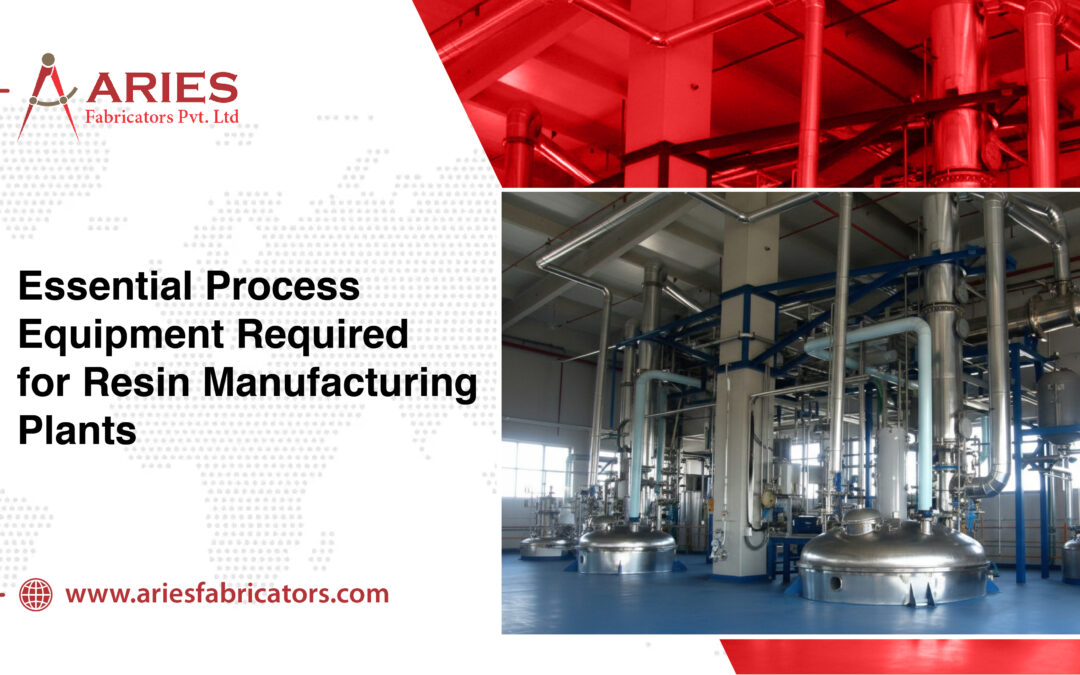
In the world of industrial chemistry, the efficiency of your production line is only as good as the machinery behind it. Whether you are producing alkyd, polyester, epoxy, or phenolic resins, the complexity of the chemical reactions involved—often requiring precise temperature control and high-pressure environments—demands specialized infrastructure.
Setting up Resin Manufacturing Plants is a capital-intensive and technical endeavor. To ensure a high-quality end product that meets international standards, one must understand the core machinery required to handle polymerization and distillation. At Aries Fabricators, we have spent decades perfecting the design and fabrication of these systems, ensuring that every piece of equipment contributes to a seamless, safe, and productive manufacturing cycle.
In this guide, we break down the essential process equipment required for modern Resin Manufacturing Plants and how they work together to deliver industrial excellence.
1. The Heart of the Process: Chemical Reactors
The most critical component in Resin Manufacturing Plants is the reaction vessel. This is where raw materials undergo polymerization under controlled conditions. Depending on the resin type, these reactors must handle temperatures ranging from 60°C to over 300°C.
- Jacketed Reactors: These are equipped with an external jacket for heating or cooling. They are ideal for maintaining a steady temperature throughout the reaction.
- Limpet Coil Reactors: For processes requiring rapid heat transfer or high-pressure steam, limpet coil reactors offer superior efficiency.
- Agitation Systems: A resin reactor is incomplete without a high-performance agitator (such as anchor, turbine, or paddle types) to ensure a homogeneous mixture and prevent localized overheating.
2. Condensers and Distillation Columns
During the synthesis of resins, especially in solvent-based processes, vapors are generated that need to be captured and processed. Resin Manufacturing Plants utilize vertical and horizontal condensers to convert these vapors back into liquid form.
- Fractionating Columns: These are used to separate different components based on their boiling points, ensuring the purity of the final resin.
- Shell and Tube Heat Exchangers: Often used alongside condensers, these help in managing the thermal energy of the plant, significantly reducing operational costs by recycling heat.
3. Dilution and Blending Vessels
Once the primary reaction in the kettle is complete, the concentrated resin often needs to be thinned or blended with solvents and additives. In Resin Manufacturing Plants, dilution tanks (or thinning kettles) are used for this purpose.
These vessels are typically equipped with high-speed dispersers or dual-shaft mixers to ensure that the solvent integrates perfectly with the high-viscosity resin without forming lumps or “fish-eyes.”
4. Separation and Filtration Systems
Quality control is paramount. Before the resin is sent to the filling station, it must be free from impurities and unreacted particles.
- Centrifuges: Many Resin Manufacturing Plants employ top-discharge or bottom-discharge centrifuges to separate solids from liquids.
- Sparkler Filter Press: For fine filtration, a zero-hold-up filter press is used to ensure the final product is crystal clear and meets the required micron ratings.
5. Storage and Material Handling
Raw materials like monomers, oils, and catalysts, as well as the finished resin, require robust storage solutions. Resin Manufacturing Plants rely on:
- Stainless & Mild Steel Tanks: Engineered to block impurities and endure the harsh, erosive properties of various chemical raw materials.
- Receiver Tanks: Used to collect distillate or condensed solvents for reuse in the next batch, promoting a circular and cost-effective production model.
Why Precision Engineering Matters in Resin Production
Operating Resin Manufacturing Plants involves managing exothermic reactions that can become hazardous if not monitored correctly. This is why automation and safety features—such as PLC-based control systems, pressure relief valves, and emergency cooling-water circuits—are no longer optional; they are essential.
At Aries Fabricators, we don’t just supply machinery; we provide turnkey solutions. Our equipment is designed to comply with ASME and GMP standards, ensuring that your plant is not only productive but also safe for your workforce and the environment.
The Role of Pilot Plants
Before scaling up to a 10-ton batch, most manufacturers benefit from a Multi-Purpose Pilot Plant. These smaller-scale versions of Resin Manufacturing Plants allow R&D teams to test formulations and process parameters, reducing the risk of wastage during mass production.
Conclusion:
The demand for high-performance resins in the paint, adhesive, and construction industries is at an all-time high. However, to stay competitive, your production facility must be optimized for speed, purity, and energy efficiency. From the initial reaction in a limpet coil vessel to the final filtration, every stage of Resin Manufacturing Plants requires equipment that can withstand the test of time and chemistry.
Choosing the right Engineering Solution Provider is the first step toward industrial success. With the right technology, you can ensure consistent quality, minimize downtime, and maximize your ROI.
Ready to Scale Your Resin Production?
Are you planning to set up a new facility or upgrade your existing Resin Manufacturing Plants? Aries Fabricators brings over 25 years of expertise in designing and manufacturing high-precision chemical process equipment.
Contact Our Experts Today to discuss your project requirements, or visit our Product Gallery to explore our range of reactors, heat exchangers, and turnkey resin plants. Let’s build an efficient future together!
Recent Comments