
Efficient drying is an essential part of manufacturing processes across the pharmaceutical, chemical, specialty chemical, agrochemical, food, and nutraceutical industries. Removing moisture or solvents from powders, crystals, granules, and other materials requires careful control of temperature, pressure, heat transfer, and product movement.
Traditional drying methods can sometimes involve high temperatures, extended drying cycles, and greater energy consumption. These challenges become more significant when processing heat-sensitive materials or products that require strict control over moisture content.
A Rotocone Vacuum Dryer (RCVD) provides an efficient solution by combining controlled heating, vacuum operation, and gentle product mixing. This combination helps improve heat and mass transfer while allowing drying to take place at relatively lower temperatures.
In this blog, we explore how Rotocone Vacuum Dryers improve drying efficiency, their key advantages, applications, and the factors that influence their performance.
What Is a Rotocone Vacuum Dryer?
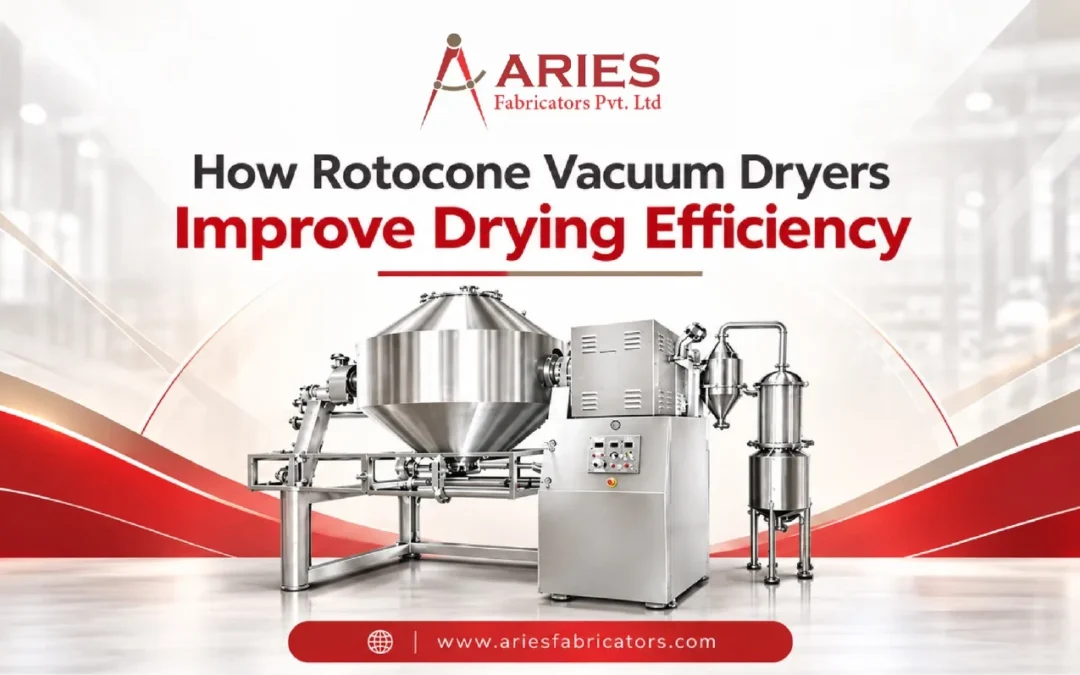
A Rotocone Vacuum Dryer is a closed industrial drying system designed for efficiently drying powders, crystals, granules, and other solid materials. The dryer typically consists of a rotating conical vessel that operates under vacuum conditions.
During operation, the product is gently lifted and cascaded as the vessel rotates. Heating is supplied through the dryer surface, while a vacuum system lowers the pressure inside the chamber. This reduces the boiling point of moisture or solvents, allowing evaporation to occur at lower temperatures.
The continuous movement of the product helps expose fresh surfaces to the heated wall, improving heat distribution and moisture removal.
The combination of vacuum drying, controlled heating, and gentle mixing makes RCVD technology suitable for applications where product quality, drying uniformity, and controlled processing are important.
How Does a Rotocone Vacuum Dryer Improve Drying Efficiency?
1. Drying at Lower Temperatures
One of the primary benefits of a Rotocone Vacuum Dryer is its ability to dry materials at lower temperatures.
When pressure is reduced inside the drying chamber, the boiling point of water and other solvents also decreases. This allows moisture to evaporate without requiring excessively high product temperatures.
Lower-temperature drying is particularly beneficial for heat-sensitive pharmaceuticals, APIs, chemicals, and specialty products that may experience degradation, discoloration, or changes in physical properties when exposed to high temperatures.
By providing controlled drying conditions, an RCVD can help maintain product quality while achieving the desired moisture level.
2. Improved Heat Transfer
Effective heat transfer is essential for reducing drying time.
In a Rotocone Vacuum Dryer, the product continuously moves as the vessel rotates. Material comes into repeated contact with the heated surface and is then redistributed throughout the vessel.
This movement helps:
- Improve contact between the product and heated surfaces
- Distribute heat more uniformly
- Reduce localized overheating
- Expose fresh product surfaces
- Improve overall drying consistency
The result is a more efficient transfer of heat from the heating medium to the product.
3. Enhanced Mass Transfer and Moisture Removal
Drying efficiency depends on both heat transfer and mass transfer.
Heat supplied to the product causes moisture or solvent to evaporate. The vacuum system then helps remove the generated vapor from the drying chamber.
The rotating action continuously exposes new product surfaces, helping moisture migrate from the material and escape into the vapor space.
Efficient vapor removal is particularly important during the later stages of drying, when removing residual moisture can become more difficult.
A properly designed vacuum system, condenser, and dryer configuration can therefore contribute significantly to overall drying performance.
4. Gentle Product Handling
Product handling is another important advantage of Rotocone Vacuum Dryers.
The vessel generally operates at relatively low rotational speeds, producing a gentle tumbling and cascading action. Unlike high-speed mechanical mixing or aggressive drying systems, this movement can reduce excessive mechanical stress on the product.
Gentle handling can be advantageous when processing:
- Pharmaceutical powders
- Crystalline materials
- Fine chemicals
- Granules
- Fragile particles
- Heat-sensitive products
By minimizing unnecessary particle breakage, the process can help maintain the physical characteristics of the finished material.
5. Better Drying Uniformity
Achieving consistent moisture content throughout a batch is a major objective in industrial drying.
Uneven product movement can result in wet pockets, while inadequate heat distribution may cause some areas to dry faster than others.
The rotating conical design of an RCVD helps continuously redistribute the product within the vessel. As the material moves, different portions of the batch are repeatedly exposed to the heated surface.
This can contribute to:
- More uniform moisture removal
- Consistent final moisture content
- Reduced risk of localized overheating
- Improved batch-to-batch consistency
Actual drying uniformity depends on equipment design, product characteristics, loading level, and operating parameters.
6. Potential Reduction in Drying Time
Drying time is a major factor in manufacturing productivity.
The combination of efficient heat transfer, continuous product movement, vacuum operation, and effective vapor removal can help reduce the time required to reach the target moisture level.
Shorter drying cycles may provide several operational benefits, including increased equipment availability and improved production throughput.
However, the actual cycle time depends on factors such as product properties, initial moisture content, required final moisture, batch size, vacuum level, heating temperature, and material characteristics.
Therefore, dryer selection should always be based on application-specific process requirements.
7. Improved Energy Utilization
Energy efficiency is becoming increasingly important for industrial manufacturers.
A Rotocone Vacuum Dryer can support efficient energy utilization by allowing evaporation at lower temperatures and promoting effective heat transfer.
The rotating movement helps distribute the product across the heated surface, while vacuum operation facilitates moisture or solvent evaporation under controlled conditions.
Energy consumption can vary significantly depending on:
- Product moisture content
- Batch size
- Heating medium
- Drying temperature
- Vacuum level
- Dryer insulation
- Condenser efficiency
- Drying cycle duration
Proper equipment sizing and process optimization are therefore essential for achieving efficient operation.
8. Closed-System Processing
Rotocone Vacuum Dryers can be designed for closed-system operation, making them suitable for applications involving solvents or materials that need protection from the surrounding environment.
A closed drying system can help reduce product exposure to atmospheric contaminants and limit the release of solvent vapors into the working area when combined with appropriate condensers and vacuum systems.
This is particularly relevant in industries where containment, solvent recovery, product protection, and controlled processing are important considerations.
9. Suitable for Heat-Sensitive Products
Many pharmaceutical and chemical products are sensitive to elevated temperatures.
Conventional atmospheric drying may require higher temperatures to achieve efficient evaporation. Vacuum drying provides an alternative by lowering the boiling point of the liquid component.
This enables manufacturers to remove moisture or solvents while maintaining comparatively lower product temperatures.
For heat-sensitive materials, careful control of the heating temperature and vacuum conditions is essential to prevent thermal degradation and maintain product quality.
Key Factors Affecting Rotocone Vacuum Dryer Performance
Although RCVD technology offers several advantages, drying performance depends on correct equipment selection and process optimization.
Important factors include:
Vacuum Level
The operating vacuum influences the boiling point and evaporation conditions. Maintaining the required vacuum level consistently is essential for predictable drying.
Heating Temperature
The heating temperature determines how much energy is transferred to the product. Excessive temperature may affect product quality, while insufficient heating can increase drying time.
Rotation Speed
Rotation speed affects product movement, mixing, and contact with the heated surface. The appropriate speed depends on the material being processed.
Product Loading
Overloading the dryer can affect product movement and heat transfer. Proper loading is important for maintaining efficient drying conditions.
Particle Characteristics
Particle size, shape, density, porosity, and moisture distribution can influence drying behavior and the time required to achieve the desired final moisture level.
Condenser and Vacuum System
Efficient removal and condensation of moisture or solvent vapors are critical to maintaining stable vacuum conditions and supporting continuous drying.
Applications of Rotocone Vacuum Dryers
Because of their controlled and gentle drying characteristics, Rotocone Vacuum Dryers are used across several industries.
Typical applications include:
- Pharmaceutical manufacturing
- Active Pharmaceutical Ingredients (APIs)
- Bulk drugs
- Fine chemicals
- Specialty chemicals
- Agrochemicals
- Pigments and dyes
- Food ingredients
- Nutraceuticals
- Chemical intermediates
- Solvent-based products
- Heat-sensitive powders and crystals
The final equipment configuration should be selected according to the specific material and process requirements.
Rotocone Vacuum Dryer vs. Conventional Drying
The main difference between an RCVD and many conventional drying systems is the combination of vacuum, controlled heating, and gentle product movement.
| Feature | Rotocone Vacuum Dryer | Conventional Drying Systems |
| Operating pressure | Vacuum | Often atmospheric |
| Drying temperature | Relatively lower | Can be higher |
| Product movement | Gentle tumbling | Depends on equipment |
| Heat-sensitive materials | Suitable | Application dependent |
| Drying uniformity | High with suitable design | Varies |
| Closed operation | Possible | Depends on system |
| Solvent handling | Suitable with proper configuration | Application dependent |
This makes Rotocone Vacuum Dryers an important option for manufacturers looking for controlled and efficient drying of sensitive solid materials.
Why Proper RCVD Design Matters
Selecting a Rotocone Vacuum Dryer should not be based only on batch capacity.
The equipment should be engineered according to the product’s physical and chemical characteristics, required drying temperature, moisture content, solvent properties, vacuum requirements, heating area, batch size, and desired cycle time.
Important design considerations may include:
- Vessel capacity and geometry
- Heating surface area
- Rotation mechanism
- Vacuum system
- Condenser capacity
- Product loading
- Material of construction
- Sealing arrangement
- Temperature and pressure controls
- Safety requirements
An application-specific approach can help ensure reliable and repeatable drying performance.
Conclusion
A Rotocone Vacuum Dryer improves drying efficiency by combining vacuum operation, controlled heating, and gentle product movement. By lowering the boiling point of moisture and solvents, the system can support drying at relatively lower temperatures while promoting effective heat and mass transfer.
Its ability to provide controlled drying, gentle product handling, improved uniformity, and closed-system operation makes RCVD technology suitable for a wide range of pharmaceutical, chemical, specialty chemical, food, and nutraceutical applications.
For manufacturers looking to improve drying performance, reduce unnecessary thermal exposure, and achieve consistent final moisture levels, selecting the right Rotocone Vacuum Dryer and optimizing its operating parameters are important steps toward a more efficient drying process.
Looking for a Rotocone Vacuum Dryer for Your Application?
Aries Fabricators provides engineered process equipment for industrial applications where controlled and efficient drying is required.
If you are evaluating a Rotocone Vacuum Dryer for pharmaceutical, chemical, specialty chemical, or other industrial applications, contact Aries Fabricators to discuss your product characteristics, batch capacity, drying requirements, and process conditions.
Talk to Aries Fabricators about your industrial drying requirements.
Recent Comments